Augustín Kubovič
Fighter pilot and participant in the Slovak National Uprising (19 September 1920 – 25 October 1944)
Key facts
From the Eastern Front to the Slovak National Uprising
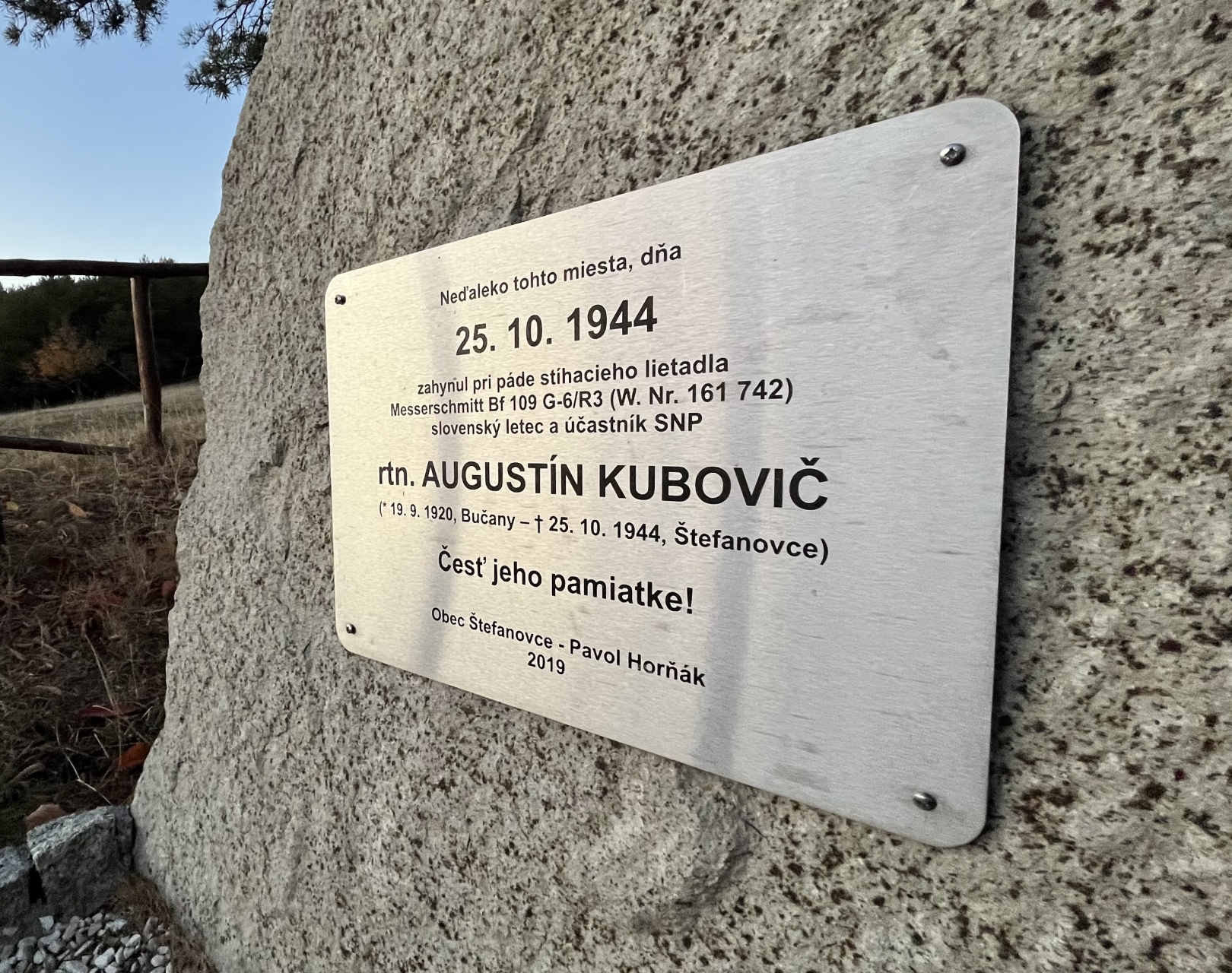
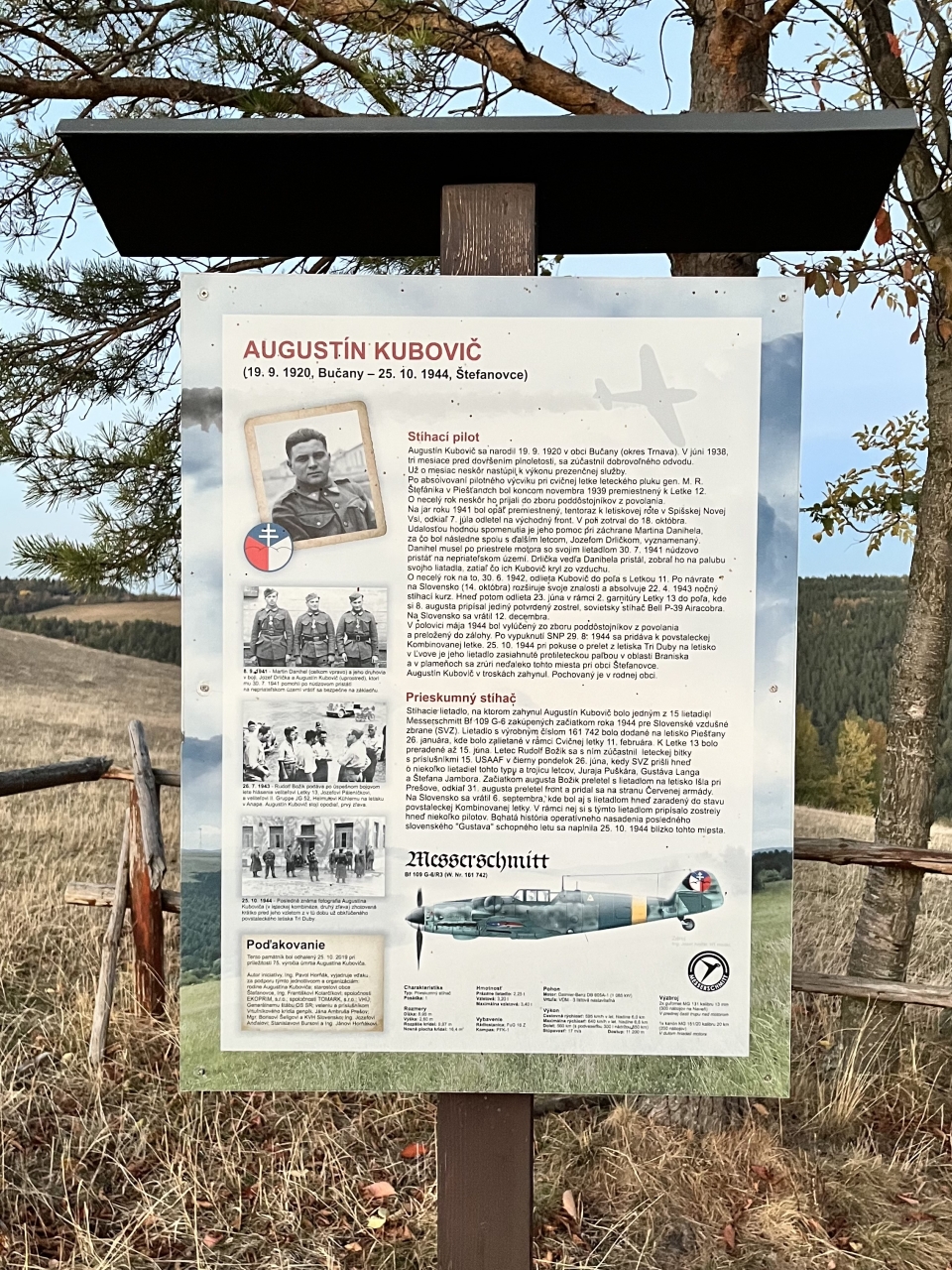
Augustín Kubovič was born on 19 September 1920 in Bučany (Trnava District), the seventh child of farmers František Kubovič and Agnesa, née Bachratá. In June 1938, three months before reaching the age of majority, he volunteered for military service and enlisted for active duty the following month. After completing pilot training with the training flight of the General M. R. Štefánik Air Regiment in Piešťany, he was transferred to Flight 12 in late November 1939. Less than a year later, he was accepted into the professional non-commissioned officer corps. In spring 1941, he was transferred to the air unit in Spišská Nová Ves, from where he flew to the Eastern Front on 7 July. He remained there until 18 October. He played an important role in rescuing pilot Martin Danihel, whose aircraft had to make an emergency landing in enemy territory on 30 July 1941 after engine trouble. Jozef Drlička landed and took Danihel aboard his aircraft, while Kubovič provided aerial cover. For this action, Kubovič and Drlička received the Slovak decoration For Bravery, Third Class, and the German Iron Cross, Second Class. On 30 June 1942, Kubovič flew with Flight 11 for another deployment to the Eastern Front; he returned to Slovakia on 14 October. He subsequently completed a night-fighter course on 22 April 1943. On 23 June, he flew to the front with the second contingent of Flight 13, and on 8 August he scored a confirmed victory over a Soviet Bell P-39 Airacobra fighter. He returned to Slovakia on 12 December 1943. In mid-May 1944, he was discharged from the professional non-commissioned officer corps and placed in the reserve. Following the outbreak of the Slovak National Uprising on 29 August 1944, he joined the insurgent Combined Flight at Tri Duby airfield. On 25 October 1944, he attempted to fly from Tri Duby to the airfield in Lviv. He took off in a Messerschmitt Bf 109 G-6/R3, Werknummer 161 742. While flying over the Branisko area, the aircraft was probably hit by German anti-aircraft fire and crashed in flames near Štefanovce. Augustín Kubovič died in the wreckage at the age of 24. After the crash, he was buried in the cemetery at Štefanovce. In April 1946, his remains were transferred to his native Bučany, where he was reburied. After the war, he was posthumously promoted to Staff Sergeant of Aviation. His story reflects the complex fate of Slovak military airmen who served on several fronts and ultimately joined the fight against the German occupation during the Slovak National Uprising.
About the memorial site
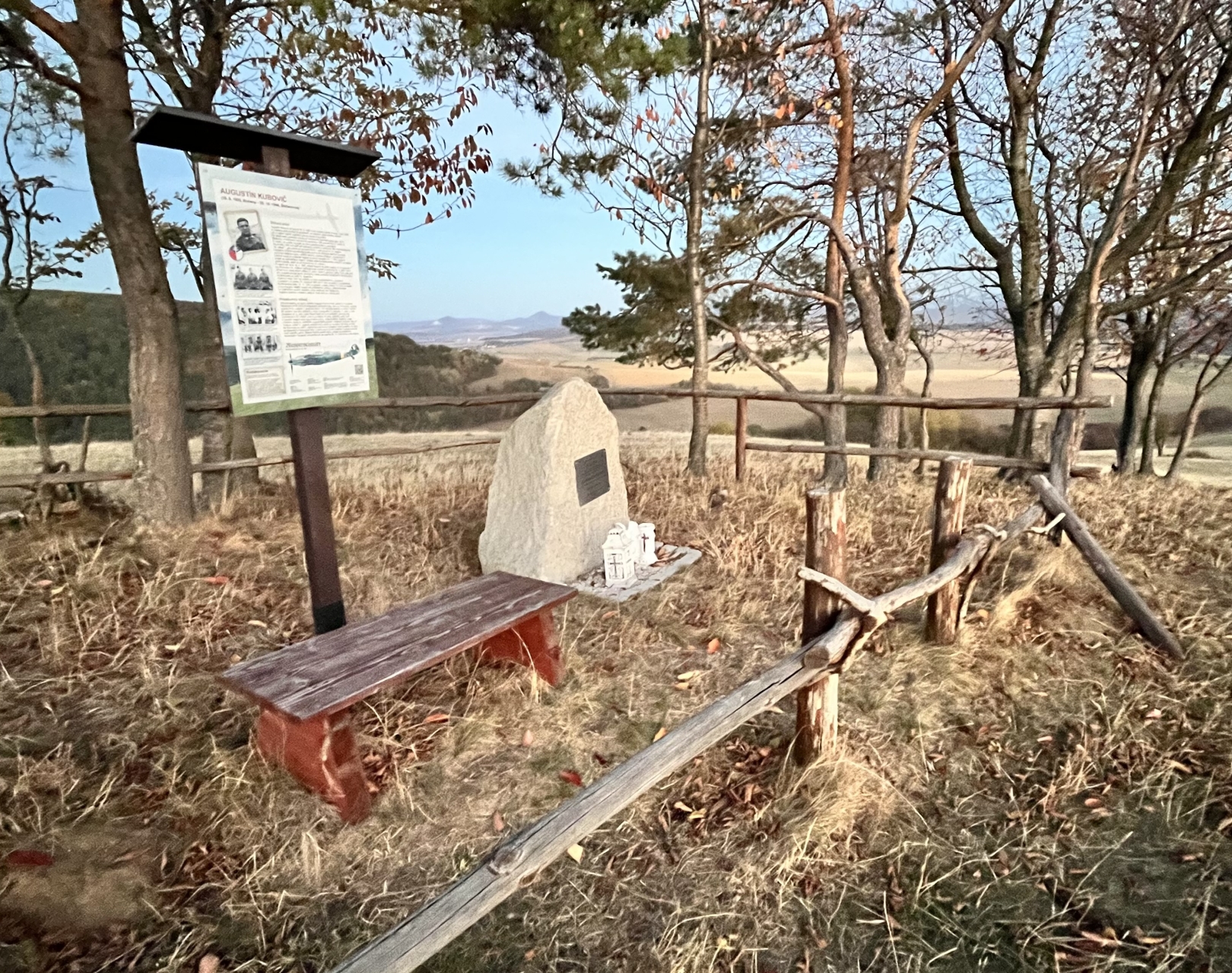
The memorial to Augustín Kubovič and its information panel are located in the territory of the village of Štefanovce in Prešov District, at the site where his aircraft crashed on 25 October 1944. On his final flight, Kubovič attempted to leave the insurgent-held territory and reach the airfield in Lviv. According to historical sources, his aircraft was probably hit by German anti-aircraft fire while flying over the Branisko area and crashed near the present-day memorial site. The information panel also describes the history of the specific aircraft: a Messerschmitt Bf 109 G-6/R3, Werknummer 161 742. It was one of 15 Bf 109 G-6 aircraft purchased in early 1944 for the Slovak Air Force. It was delivered to Piešťany on 26 January 1944 and test-flown by the training flight on 11 February; it was assigned to Flight 13 on 15 June. On 26 June 1944, pilot Rudolf Božík flew it in combat against aircraft of the U.S. Fifteenth Air Force. In early August, the aircraft moved to Išla airfield near Prešov, and on 31 August Božík flew it across the front to the Soviet side. The aircraft returned to Slovakia on 6 September and joined the insurgent Combined Flight at Tri Duby airfield. Several pilots achieved aerial victories while flying it with the Combined Flight, until it became the aircraft of Kubovič’s final flight on 25 October. Kubovič’s remains were first buried in the cemetery at Štefanovce. In April 1946, his family transferred them to his native Bučany, where he was reburied. The memorial commemorates not only the site of his tragic death, but also the fate of a pilot and the particular aircraft that took part in the fighting during the Slovak National Uprising.
Unveiling of the memorial and information panel
The memorial to Augustín Kubovič and its information panel were officially unveiled on 25 October 2019, exactly 75 years after his death. The initiative to establish the memorial came from Ing. Pavol Horňák of Košice, and its construction was organised by the Štefanovce Municipal Office. The commemorative gathering was attended by the pilot’s relatives, the village mayor Ing. František Kolarčík, Brigadier General Ing. Martin Michalko, members of the Slovak Armed Forces Air Force from Prešov, and other guests, including some of the last surviving participants in the Slovak National Uprising. The ceremony included a wreath-laying tribute. The programme continued at the municipal office with a presentation of photographs of Augustín Kubovič and fragments recovered from his aircraft. On that occasion, Ing. Pavol Horňák presented the municipality with commemorative pictures and cards containing fragments of the downed aircraft. The unveiling helped preserve the memory of Kubovič’s final flight and commemorated his contribution to the struggle for liberation during the Second World War.
Location
Photo gallery