Sugar Report
B-17G Flying Fortress, 15th Air Force | December 26, 1944
Quick Facts
The Final Mission of Sugar Report
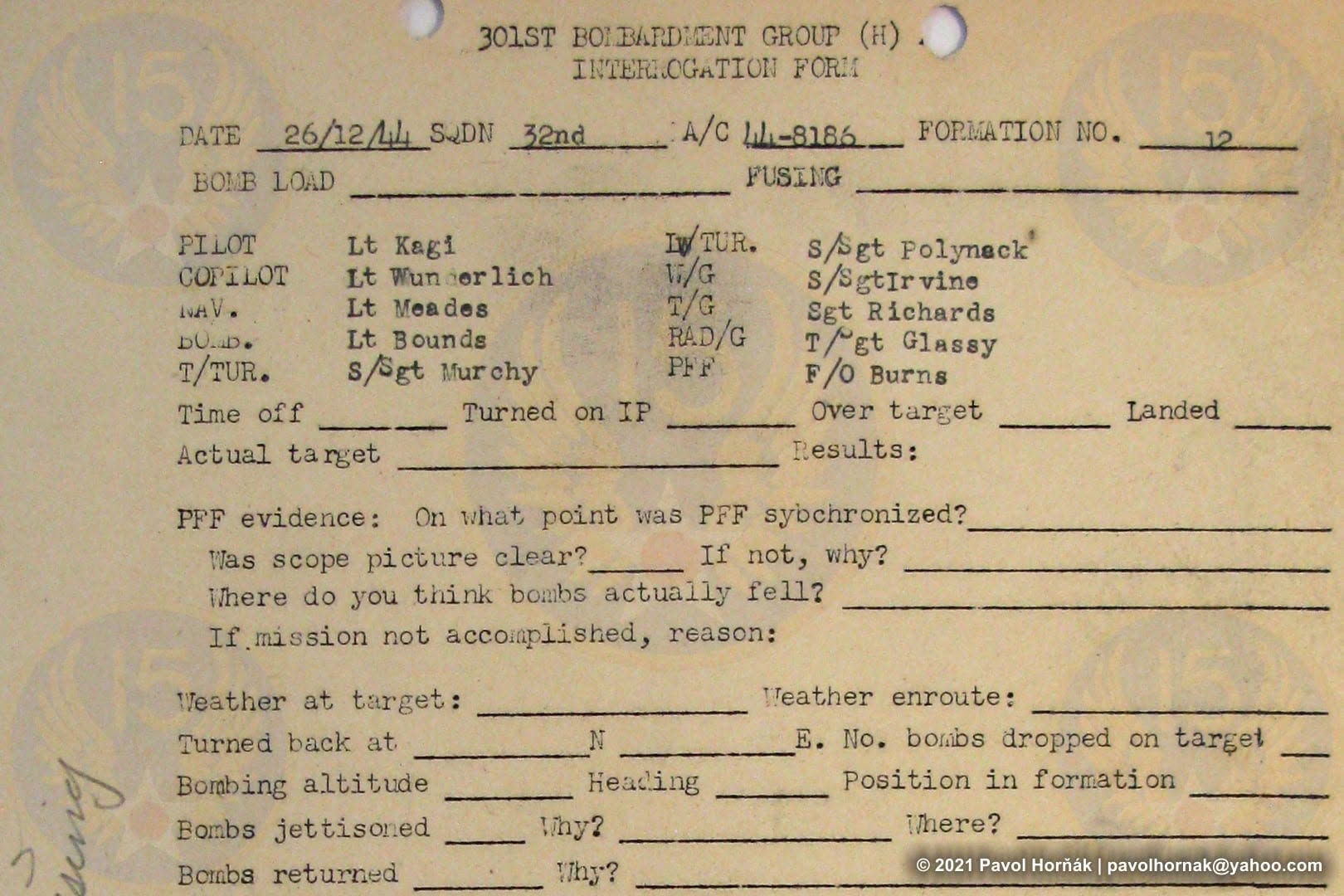
On Tuesday, December 26, 1944, shortly after eight in the morning, 28 B-17G bombers belonging to the 301st Bombardment Group of the U.S. 15th Air Force took off from an American air base near Lucera in southern Italy. Among them was Sugar Report, serial number 44-8186, assigned to the 32nd Bombardment Squadron. The aircraft was piloted by 1st Lt. Ralph H. Kagi.
The wider formation of 1,013 Allied aircraft was targeting German oil refineries and industrial facilities in the Blechhammer and Odertal areas, as well as near Auschwitz. The attack was part of the Allied campaign to weaken Germany’s ability to produce fuel for its war machine.
After approximately four hours of flight, the 301st Group’s bombers reached the target area around Blechhammer, where they encountered intense German anti-aircraft fire. Sugar Report was also hit. The damage affected several engines and some aircraft systems; in addition, the bombs could not be released from the bomb bay in the normal way.
Despite the severe damage, the crew decided to continue east toward territory controlled by the Red Army. Crew member T/Sgt. Sinclair J. Murchy Jr. helped release the remaining bombs, using a screwdriver to move bombs that had become jammed in the bomb bay. The aircraft was then able to continue flying, although it was badly damaged and a return to its base in Italy was no longer a realistic option.
Pilot Ralph H. Kagi found a suitable place for an emergency landing on a frozen, ploughed field near the village of Hatalov in eastern Slovakia, not far from a Soviet field airstrip established after the village was liberated. The aircraft touched down about one kilometre behind the front line at the time. Despite the extensive damage, all ten crew members survived the landing without serious injury.
After landing, the crew met Soviet soldiers and local residents, who provided assistance and hospitality. The airmen spent the following weeks in the villages of Hatalov, Budkovce and Dúbravka. Their stay ended on January 23, 1945, when they set out to rejoin their units. Their route took them through Sanok, Stryi, Lviv, Kyiv and Poltava, and then through Tehran, Cairo and Athens.
After 51 days, the airmen returned to their base at Lucera on February 15, 1945, and later continued their service until the end of the war in Europe. Sugar Report was too badly damaged to fly again. Its story nevertheless became a remarkable example of survival and of the assistance provided to American airmen by local residents and Soviet soldiers at the end of the Second World War.
The Crew of Sugar Report
The crew consisted of ten American airmen. The information below includes their names, ranks, positions, and available birth and death dates. Details that could not be reliably confirmed have not been added.
Ralph Henry Kagi
William Floyd "Bill" Wunderlich Jr.
Frederick S. Meade
Donald Robert Burns
Windsor Fowler Bounds
Sinclair Joseph "Joe" Murchy Jr.
Maurice Albert "Maury" Glassy
Matthew "Poly" Polynack
Robert Duke Irvine
Robert Elsworth Richards
History of the Memorial
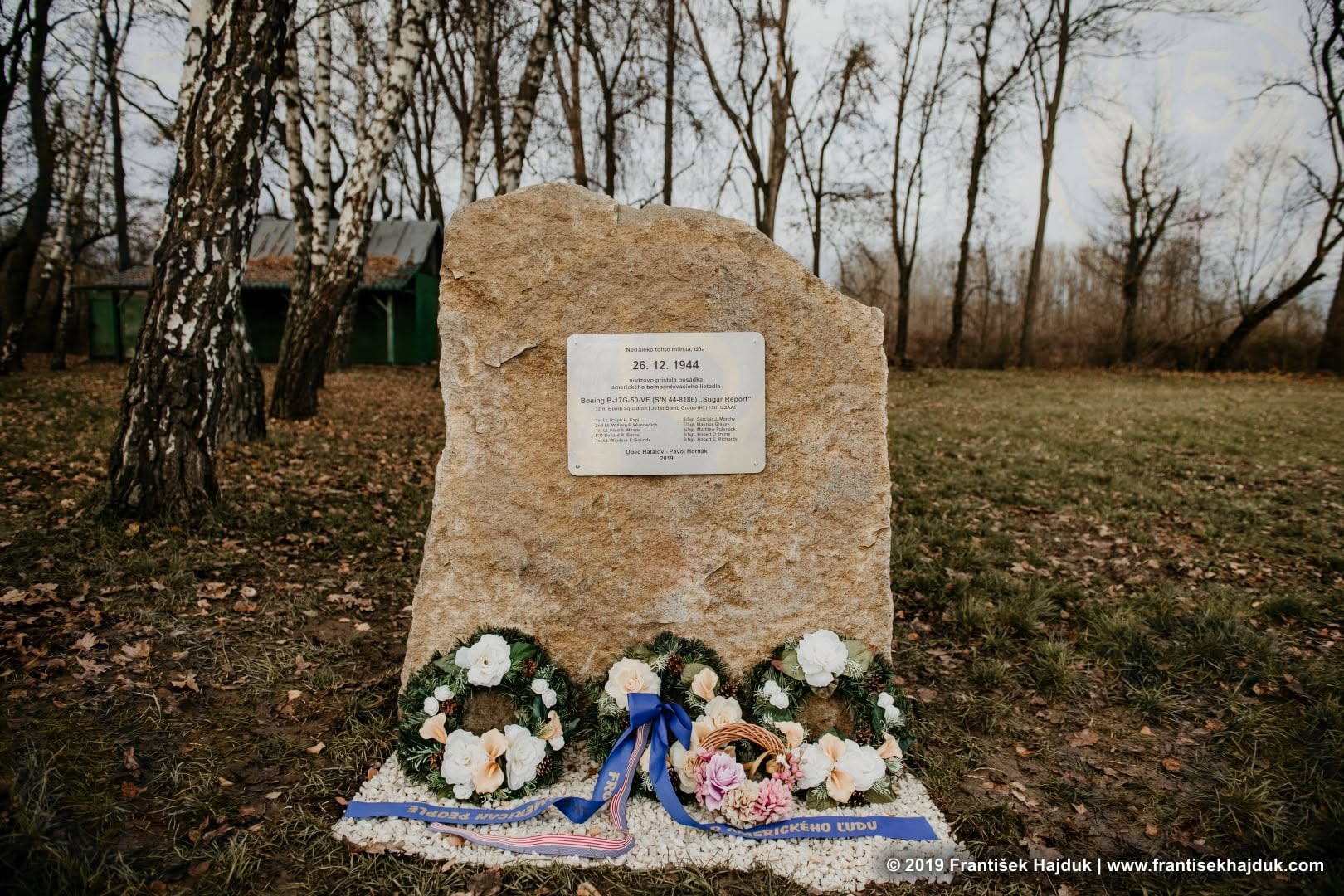
The memorial near the village of Hatalov commemorates the ten-man crew of the American Boeing B-17G-50-VE Sugar Report (serial number 44-8186), which made an emergency landing in a field near the village on December 26, 1944. The aircraft had been severely damaged by German anti-aircraft fire during a bombing mission over the Blechhammer area. All ten crew members survived.
The memorial was initiated by Pavol Horňák and established with the involvement of the village of Hatalov and the support of the U.S. Embassy in Slovakia. It was officially unveiled on November 21, 2019. It commemorates not only the emergency landing, but also the help given to the airmen by residents of Hatalov, Budkovce and Dúbravka, as well as by Soviet soldiers.
The story of Sugar Report is remarkable because all ten airmen managed to reach the ground safely despite the extensive damage to their aircraft. They remained in the region until January 23, 1945, when they began the long journey back to their units. They returned to their base in southern Italy on February 15, 1945.
The memorial preserves the memory of the crew and of the people who helped them in difficult wartime conditions. It stands as a reminder of the humanity and solidarity shown in the midst of war, and of the historical events that connected American airmen with communities in eastern Slovakia.
Memorial Unveiling in 2019
The memorial to the crew of Sugar Report was officially unveiled on November 21, 2019. The project was initiated by Pavol Horňák, in cooperation with the village of Hatalov and with support from the U.S. Embassy in Slovakia.
The memorial is dedicated to the ten crew members of the B-17G who made an emergency landing near Hatalov on December 26, 1944. Their story also honours the assistance provided by residents of Hatalov, Budkovce and Dúbravka, who helped the airmen through the final weeks of 1944 and the beginning of 1945 before they returned to their units.
Location
The memorial is located near the village of Hatalov in eastern Slovakia, close to the place where the American B-17G Sugar Report made its emergency landing on December 26, 1944.
Photo Gallery